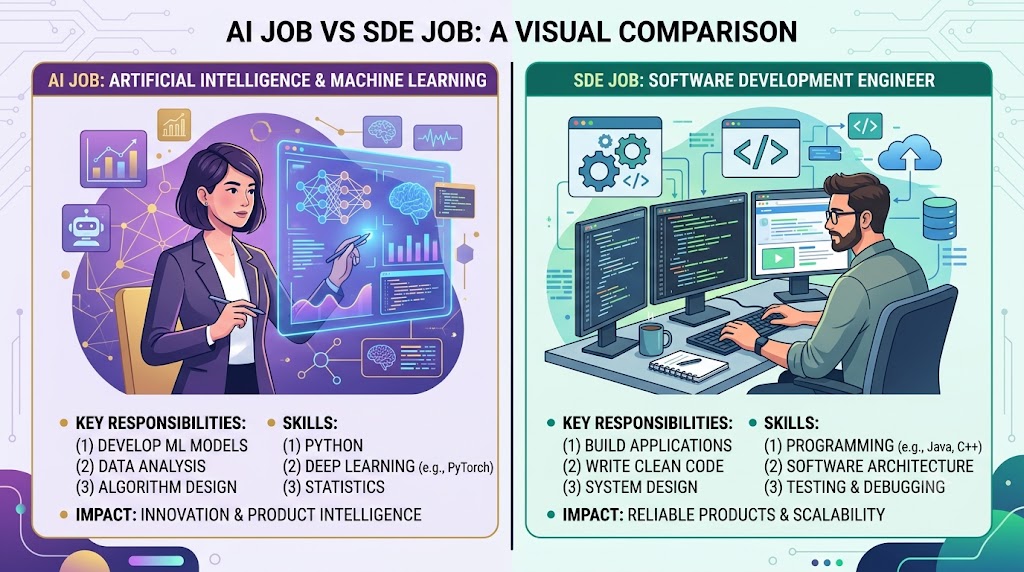
AI Engineer vs Software Engineer: Which Career Holds the Future?
Introduction
The tech job market is in constant flux, and two of the most coveted paths today are
Artificial Intelligence (AI) Engineer and
Software Development Engineer (SDE). While both roles share a foundation in programming, their day‑to‑day responsibilities, required skill sets, and future trajectories differ dramatically. In this post we dive deep into market data, skill‑gap analyses, automation risk, and compensation trends to answer the burning question:
Which one is the future job?
1. Market Demand & Growth Trajectory
| Metric | AI Engineer | Software Engineer |
|---|
| CAGR (2023‑2028) | 31% (IDC) | 12% (BLS) |
| 2024 Job Postings (LinkedIn) | 1.2M | 3.4M |
| Top Hiring Sectors | Healthcare, Autonomous Vehicles, FinTech | SaaS, Cloud, Gaming |
The AI market is exploding, driven by generative models, foundation models, and edge‑AI deployments. However, SDE roles remain the backbone of every digital product, ensuring a massive absolute volume of opportunities.
2. Core Skill‑Set Comparison
2.1 AI Engineer
Mathematics & Statistics: Linear algebra, probability, optimization.Machine Learning Frameworks: TensorFlow, PyTorch, JAX.Data Engineering: ETL pipelines, feature stores, data versioning (DVC, LakeFS).Model Ops: CI/CD for models (Kubeflow, MLflow), monitoring drift.Domain Knowledge: NLP, CV, RL depending on vertical.2.2 Software Development Engineer
Programming Mastery: System‑level languages (C++, Rust) and high‑level (Java, Go, TypeScript).Software Architecture: Micro‑services, event‑driven design, CAP theorem.DevOps & Cloud: Kubernetes, Terraform, CI/CD pipelines (GitHub Actions, Jenkins).Testing & Quality: Unit, integration, property‑based testing (Hypothesis, QuickCheck).Performance Engineering: Profiling, concurrency, latency budgeting.
3. Salary & Compensation Trends
According to
Hired and
Levels.fyi, the median total compensation (base + equity) in the US for 2024 is:
AI Engineer: $210k – $280k (senior/lead)SDE (L5/L6): $190k – $260kEquity upside in AI startups can be substantial, but SDEs often enjoy more stable compensation across industries.
4. Automation Risk & Longevity
| Role | Tasks Susceptible to Automation | Human‑Centric Value |
|---|
| AI Engineer | Hyperparameter tuning (auto‑ML), model versioning scripts | Research, novel model architecture, ethical AI, interpretability |
| SDE | Boilerplate CRUD scaffolding, CI pipeline templates | System design, performance-critical code, security hardening |
Both roles will see parts of their workflow automated, but the creative, research‑driven aspects of AI engineering are harder to replace in the near term, while core systems engineering remains indispensable.
5. Hybrid & Emerging Roles
The industry is converging:
MLOps Engineer – blends SDE DevOps expertise with AI model lifecycle.AI‑Powered Platform Engineer – builds platforms that expose AI capabilities via APIs.Full‑Stack AI Engineer – integrates front‑end (React, Next.js) with model inference services.Investing in a hybrid skill set can future‑proof your career.
6. Decision Framework
mermaid
flowchart TD
A[Your Interests] -->|Love Math & Data| B[AI Engineer]
A -->|Enjoy Systems & Architecture| C[Software Engineer]
B --> D{Market Trend}
C --> D
D -->|High Growth| E[Focus on AI]
D -->|Stable Demand| F[Focus on SDE]
E --> G[Add MLOps Skills]
F --> H[Add Cloud Native Skills]
Assess Passion – Do you thrive on experimenting with models or building scalable systems?Evaluate Geography – AI hubs (San Francisco, Boston, Toronto) vs. broader SDE hotspots.Skill Gap – Identify the top 3 gaps and create a 6‑month learning plan.Future‑Proof – Aim for MLOps or AI‑Platform expertise to stay versatile.
7. Conclusion
Both AI engineering and software development are
future‑proof, but they serve different strategic needs. AI roles are growing faster and command premium compensation for research‑intensive talent, while SDE roles offer broader stability and are indispensable for any tech stack. The smartest career move in 2024 is to
anchor yourself in solid software engineering fundamentals and then
layer AI specialization (or MLOps) on top. This hybrid approach maximizes employability, salary upside, and resilience against automation.
Ready to future‑proof your career? Start by mastering data structures, then pick a deep‑learning framework and build an end‑to‑end model‑inference service on Kubernetes.
Happy coding!